Journal
18K versus 14K versus 9K gold: what the karat actually costs
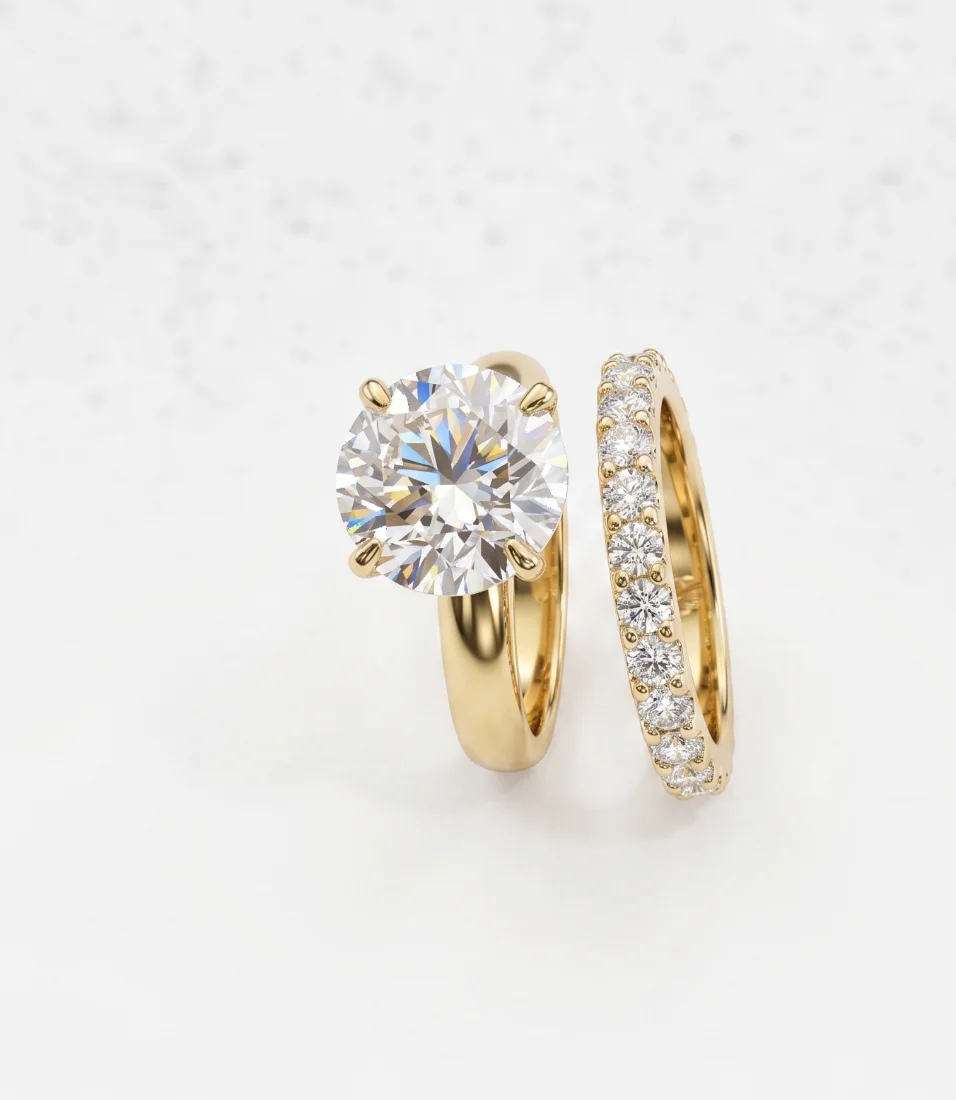
Two rings, the same design, the same weight. One is quoted at ₹73,701 and the other at ₹43,202. Neither jeweller is lying. The difference is the karat, and the karat changes three things at once: how much gold is in the metal, what a gram of it costs, and how the piece will wear over ten years.
This page works the numbers at today's Mumbai rate so the comparison is visible rather than argued.
Purity, and the ratio used to price it
Karat is a measure of gold content out of twenty four parts. 24K is 99.5 per cent gold, which is too soft for a ring that will be worn daily. The rest is alloy, added for hardness and for colour. Mumbai trade practice prices 18K at a ratio of 0.76 against 24K, slightly above the nominal 75 per cent, and the estimate you receive from us uses the same ratio.
| Karat | Standard purity | Ratio used | Colour | Typical use |
|---|---|---|---|---|
| 24K | 99.5% | 1.00 | Deep yellow | Coins and bars, not settings |
| 22K | 91.6% | not priced | Rich yellow | Traditional heavy pieces |
| 18K | 75.0% | 0.76 | Warm yellow or white | Fine jewellery, diamond settings |
| 14K | 58.5% | 0.595 | Paler yellow | Everyday wear, lower budget |
| 9K | 37.5% | 0.395 | Faint yellow | Lightweight, entry price |
22K is common in Indian jewellery but we do not price it, because a 22K setting is soft enough that claws wear and stones loosen. If a piece you own is 22K, we will tell you what that means for resetting it.
The same 5.5 gram ring in three karats
A plain ring, 5.5 grams, no stones, worked at the rate on 25 October 2026. The making charge is ₹1,800 per gram in every column, and GST is 3 per cent. Nothing else changes except the metal.
| Line | 18K | 14K | 9K |
|---|---|---|---|
| Gold per gram | ₹11,210 | ₹8,776 | ₹5,826 |
| Gold for 5.5 g | ₹61,654 | ₹48,268 | ₹32,044 |
| Making at ₹1,800/g | ₹9,900 | ₹9,900 | ₹9,900 |
| Subtotal | ₹71,554 | ₹58,168 | ₹41,944 |
| GST 3% | ₹2,147 | ₹1,745 | ₹1,258 |
| Total | ₹73,701 | ₹59,913 | ₹43,202 |
| Difference from 18K | baseline | −₹13,788 | −₹30,499 |
The gap between 18K and 9K on this ring is ₹30,499, which is 41 per cent of the 18K price. That is the real decision, and it is not a small one.
What the extra money buys, and what it does not
18K costs more because it contains more gold, and gold is the part that holds value. A piece bought at 18K will be worth more at resale for the same weight, because the metal itself is worth more. That is the straightforward part.
The less obvious part is durability of the setting. 18K is hard enough to hold a claw under daily load and yellow enough that white rhodium plating is optional rather than essential. 14K is harder still and resists scratching better, which is why it is popular for rings worn every day, but the colour is paler and some buyers dislike it against the skin. 9K is the most scratch resistant of the three and the least gold, and on a diamond piece it can look mean next to a bright stone.
Where the karat matters least is the stone. A diamond does not care what holds it, as long as the setting is sound. If the choice is between a 9K ring with a well-cut diamond and an 18K ring with a dull one, the 9K piece is the better jewellery. Purity is the second question, not the first.
How to check a karat claim
Every piece of gold jewellery sold in India must carry a BIS hallmark: a purity mark, a jeweller's identification mark, and a six-digit HUID that can be verified through the BIS Care app. Ask for the hallmark before the invoice. If a piece is described as 18K and the hallmark is absent or unreadable, the description is a claim rather than a fact.
We list the karat, the net gold weight and the rate used on every estimate, so the figure can be checked against the hallmark when the piece arrives.
Frequently asked
Is 18K better than 14K?
It contains more gold and costs more, so it holds value better. 14K is harder and more scratch resistant. For a daily-wear ring, 14K is a reasonable choice. For a piece meant to be kept and resold, 18K is the safer one.
Why is your 18K ratio 0.76 rather than 0.75?
It is the convention used in the Mumbai trade for pricing 18K against the 24K rate, and it is slightly generous to the buyer relative to the nominal 75 per cent gold content.
Do you price 22K?
No. 22K is too soft for claw settings and wears at the points where stones are held. We price 24K, 18K, 14K and 9K.
If you are weighing two karats for a specific design, send a photo and we will price both the same way, with the gold, the making and the tax on separate lines.
More in the Journal
Send a photo, get an itemised estimate
Tell us what you have in mind and we will reply with the gold, the diamond, the making charge and GST listed separately. It is free, it is yours to keep, and there is no obligation to order.
Get an estimate